You've received a production sample that looks perfect. But when the main order of 5,000 belts arrives, the stitching is inconsistent, the leather is scarred, and the buckles are loose. This devastating scenario is a direct result of failing to verify the factory's Quality Control (QC) processes before production begins. A factory's claim of having "strict QC" is meaningless without tangible proof and a systematic verification method.
Verifying quality control processes in a belt factory requires a hands-on, evidence-based approach that assesses systems, not just final products. It involves auditing their raw material inspection, in-process checks at each production stage, final inspection protocols, and the training and authority of their QC team. True verification means confirming that consistent quality is engineered into their process, not just inspected out at the end.
This guide will provide a concrete framework for conducting a thorough QC process audit. We will explore how to evaluate raw material controls, monitor critical in-line production checks, scrutinize final inspection standards, and assess the human system that makes it all work.
How to Audit Raw Material and Component Controls?
The quality of a finished belt is determined the moment its components enter the factory. If a factory accepts substandard leather, weak buckles, or poor-quality thread, even the best craftsmen cannot produce a premium product. Verifying the controls at this first stage is foundational.
A professional factory will have a defined procedure for inspecting all incoming materials. This is your first line of defense against quality failures. The goal is to confirm they have a system to catch defects before they enter production, saving time and money on rework and scrap.
What Questions Reveal a Robust Raw Material QC System?
During your audit, ask these specific questions and request to see the evidence:
- "What are your acceptance criteria for leather hides?" Look for a defined standard for thickness, grain consistency, and defect tolerance (scars, bug bites). They should have a grading system.
- "Can you show me a recent incoming inspection report for leather/buckles/thread?" This report should detail the batch number, quantity inspected, defects found, and the final decision (Accept/Reject).
- "How do you store materials to prevent damage?" Leather should be stored in a controlled environment away from direct sunlight and moisture. Buckles should be organized and protected from scratching.
A factory that cannot produce these documents or show you an organized raw material warehouse is operating on an ad-hoc basis, which is a major risk. This is a key indicator of their commitment to overall quality management.
How Can You Spot Check Incoming Material Quality?
Don't just look at paperwork; inspect the materials yourself. Ask to see the raw material storage area.
- Leather: Feel the hides. Are they consistent? Check for excessive scarring or inconsistent dyeing.
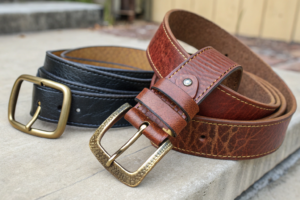
- Buckles: Examine a random sample from a bin. Look for casting flaws, sharp edges, or inconsistent plating. A good factory will have samples of approved buckles for comparison.
- Thread and Hardware: Check that they are using high-tenacity polyester thread and robust rivets, not weak, generic alternatives.
This hands-on check validates their paper-based system.
What are the Critical In-Process Quality Checkpoints?
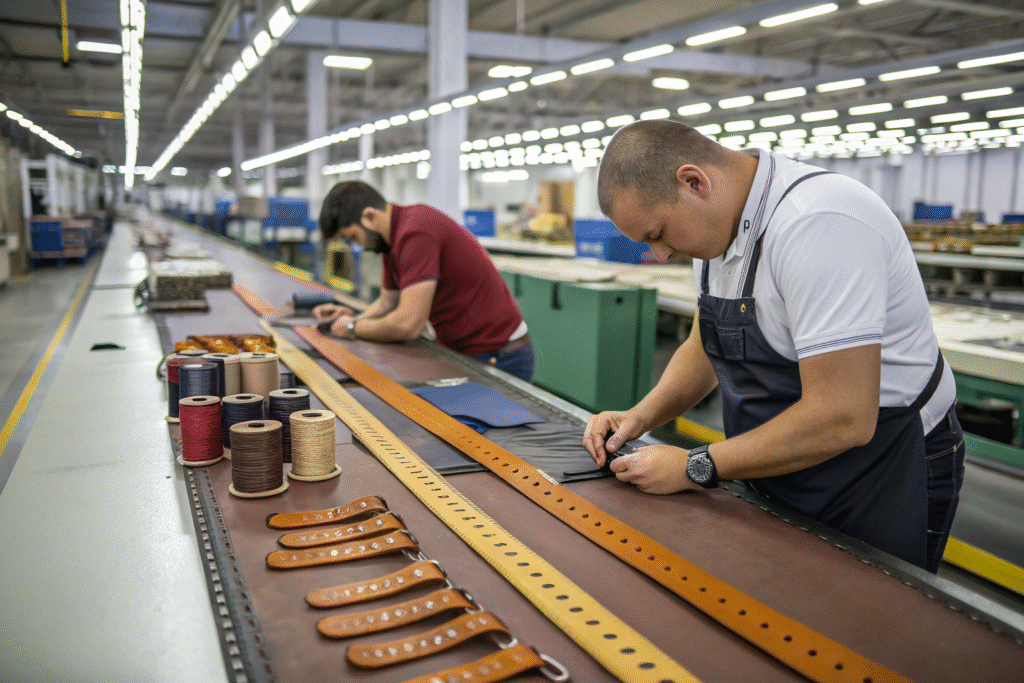
Catching a defect after a belt is fully assembled is costly and wasteful. The most effective QC happens during manufacturing, at each stage of the process. This "in-process" control prevents the multiplication of errors.
A factory with a mature QC system will have defined checkpoints on the production line where operators or dedicated inspectors verify key parameters before the semi-finished product moves to the next station. This ensures problems are fixed immediately.

Where Should the Key Inspection Stations Be Located?
Follow the production flow and identify checks at these critical stages:
- After Cutting & Skiving: Belts should be checked for dimensional accuracy (width, length) and that the skiving (thinning) is even and consistent.
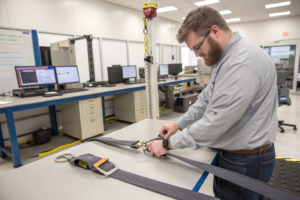
- After Stitching: This is a major failure point. Inspectors should check for stitch consistency (SPI - Stitches Per Inch), straightness, thread tension, and that no leather surface is puckered.
- After Edge Painting/Sanding: Edges should be smooth, evenly painted without drips, and the color should match the leather.
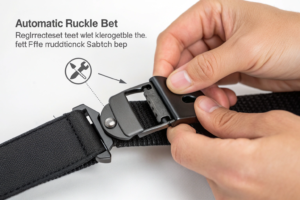
- After Buckle Attachment: The buckle must be securely attached with no movement. For automatic buckles, the mechanism must function smoothly.
What is the Evidence of Effective In-Line QC?
Look for visual proof on the factory floor:
- Quality Alert Boards: Boards that display defective samples from the line with notes on what went wrong and how to prevent it.
- First Article Inspection (FAI): A complete inspection of the first belt produced from a new batch or style, documenting all measurements before full production runs.
- Checklists at Each Station: Simple, visual guides that show operators what to look for.
This demonstrates a proactive, rather than reactive, quality culture.
How to Scrutinize the Final Random Inspection Process?
The Final Random Inspection (FRI) is the last gate before shipping. This is where the factory statistically samples the order to predict the overall quality level. A poorly executed FRI gives a false sense of security.
The international standard for this is AQL (Acceptable Quality Level). Verifying that the factory follows a rigorous AQL-based inspection is critical. It standardizes the decision of whether to ship or not.

What Does a Proper AQL Inspection Look Like?
For a typical belt order, the factory should be following this general AQL (Level II) principle:
- They determine the sample size randomly from the entire batch.
- They inspect for two types of defects:
- Critical Defects: (AQL 0) e.g., a broken buckle, a sharp edge that can cut. Finding any critical defect can lead to batch rejection.
- Major Defects: (AQL 2.5) e.g., misaligned stitching, poor color match, scratches. These affect usability and appearance.
- Minor Defects: (AQL 4.0) e.g., minor dust, slight color variation. These do not affect function.
Ask to see their AQL inspection report for a previous order. It should detail the sample size, number of defects found by category, and the final pass/fail decision. This data-driven approach is a hallmark of a professional manufacturing partner.
What Tools and Environment are Used for Final Inspection?
The inspection area should be equipped for accuracy:
- Proper Lighting: Standardized D65 light boxes to check color consistency under correct illumination.
- Measurement Tools: Calipers for measuring belt width and thickness, tape measures for length.
- Functionality Tests: Buckles are repeatedly fastened and unfastened to test durability.
A factory that performs final inspection under dim, variable lighting without proper tools cannot reliably assess its own product quality.
How to Assess the Human QC System?
The most sophisticated processes are useless without competent, empowered people to execute them. The structure, training, and authority of the QC team is the engine that drives the entire quality system.
A common failure point is a QC team that reports directly to the production manager, whose primary goal is output volume. This creates a conflict of interest where quality can be overridden to meet shipping deadlines.

What is the Ideal QC Team Structure?
Look for evidence of an independent QC department. The Head of Quality should have the authority to stop production or halt a shipment, regardless of production pressures. Ask directly: "Who can override a QC rejection, and under what circumstances?"
How is Training and Standardization Maintained?
Consistency is key. Ask:
- "How do you train new QC inspectors?" They should have a training program using standard samples.
- "Do you have physical 'golden samples' for each product?" These are approved samples that inspectors use as a physical benchmark for color, finish, and construction.
- "How do you ensure all inspectors judge defects the same way?" Look for regular calibration meetings where the team reviews borderline defects to align their standards.
This focus on the human system ensures that the QC processes you verified on paper are actually implemented effectively day after day.
Conclusion
Verifying quality control processes in a belt factory is a deep-dive audit that moves beyond promises to examine systems, evidence, and people. It requires checking robust raw material controls, validating critical in-process checkpoints, confirming a data-driven final inspection based on AQL standards, and assessing an independent, well-trained QC team with the authority to enforce standards. By systematically auditing these four pillars, you can separate factories with embedded quality cultures from those that merely offer empty assurances, ensuring your belt orders consistently meet the high standards your brand demands.
If you are looking for a manufacturing partner with a transparent and verifiable quality control system, we welcome audits and have the documentation and processes in place to demonstrate our commitment to excellence. Contact our Business Director, Elaine, at elaine@fumaoclothing.com to schedule a virtual or in-person tour of our QC operations.