You just received a belt shipment from China. The factory price seemed perfect. But then the final bill arrived. Shipping costs were higher than expected. Import duties added another surprise. Insurance and handling fees piled up. Your profit margin has vanished. This painful scenario happens too often. Importers focus only on the factory price. They forget the true landed cost.
True landed cost is the complete price to get products from factory floor to your warehouse. It includes product cost, international shipping, insurance, import duties, customs fees, domestic transportation, and overhead. Calculating it correctly determines your profit or loss.
This guide will walk you through the complete calculation. You will learn to identify all cost components. We will cover product costs beyond FOB, shipping and insurance variables, duty calculation methods, and hidden overhead expenses. This knowledge will protect your profit margins.
What Costs Are Included Beyond the FOB Price?
You see an attractive FOB price from a supplier. You think you know your cost. But the FOB price is just the start. Many other expenses turn that good number into a much higher landed cost. Missing these costs is a common error.
The true product cost includes the FOB price plus essential additions. These cover tooling, quality control, packaging, and documentation. These costs prepare the product for shipment. They typically add 5% to 15% to the base FOB price.

How Do Tooling and Development Fees Affect Cost?
Custom designs need special tools. A new buckle mold can cost $500 to $3000. This is a one-time expense. You must spread this cost across your total order quantity.
For example, a $1000 mold for 2000 belts adds $0.50 to each belt. For a small order of 500 belts, it adds $2.00 per belt. This significantly changes your cost calculation. Always ask your supplier about tooling costs upfront. Include them in your initial budget.
Why Must You Factor in QC and Packaging?
Quality control is not free. Professional inspection services cost $200 to $500 per visit. For an order of 5,000 belts, this adds $0.04 to $0.10 per belt.
Packaging costs money too. Simple poly bags may cost $0.10 each. Custom branded boxes can cost $0.50 to $2.00 each. These seem small. But they add up quickly across thousands of units. Always get detailed quotes for packaging.
How to Calculate International Shipping and Insurance?
Shipping costs can surprise you. A small air shipment might cost as much as the products. Ocean shipping has many hidden fees. Understanding these costs prevents budget overruns.
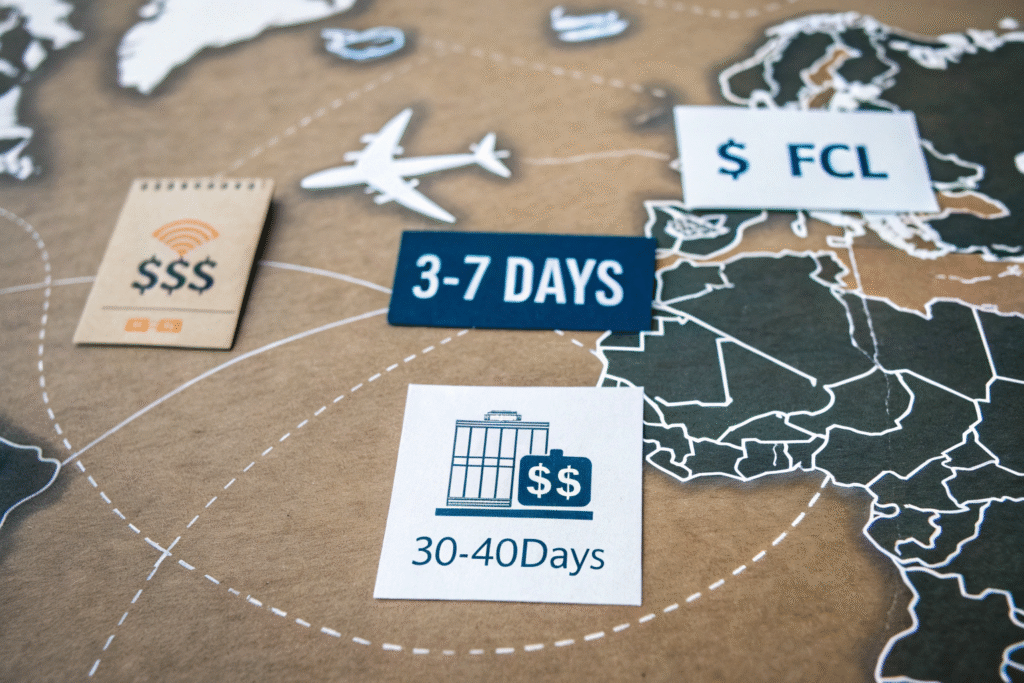
International shipping costs depend on weight, volume, and mode. The main options are air freight, LCL ocean, and FCL ocean. Each has different cost structures and transit times.
What Are the Real Costs of Air vs. Sea Shipping?
Air freight is fast but expensive. It costs $5 to $10 per kilogram. It works for samples and urgent small orders. A 50kg belt shipment might cost $500 by air.
Sea shipping is cheaper but slower. LCL (Less than Container Load) costs by volume. It might be $800 to $1,800 per cubic meter (CBM). A typical 2,000-belt shipment might take 1.5 CBM. This would cost about $1,500. FCL (Full Container Load) suits very large orders. A 20-foot container costs $3,000 to $5,000 from China to US West Coast.
What Hidden Shipping Fees Should You Expect?
The quoted freight rate is not the final cost. Budget for these extra fees:
- Fuel Surcharge: Changes monthly. Adds 15% to 30% to base rate.
- Terminal Handling: Ports charge for handling. $100 to $300 at each end.
- Customs Bond: Required for US imports. $250 to $500 per shipment.
- Cargo Insurance: Typically 0.3% to 0.5% of shipment value.
These fees can add 25% to 40% to your base shipping cost. Always ask your freight forwarder for a full quote with all charges.
How to Calculate Import Duties and Taxes for Belts?
Import duties are a tax on your goods. Many importers forget to include them. This is a costly error. Duties can add 4% to 10% to your product cost.
The duty rate depends on belt material and construction. The United States uses HTS (Harmonized Tariff Schedule) codes. You must classify your belts correctly to know the duty rate.

What is the Correct HTS Code for Your Belts?
Belts fall under HTS Chapter 42. The exact code depends on material:
| Belt Material | HTS Code | General Duty Rate |
|---|---|---|
| Leather Surface | 4203.30.00 | 4.5% |
| Reinforced Plastic | 4203.30.30 | 9.0% |
| Textile Materials | 4203.30.50 | 5.3% |
Genuine leather belts typically have the 4.5% rate. PU belts often fall under 9.0%. Canvas or nylon belts usually get 5.3%. Choose materials with duty rates in mind.
How is the Duty Amount Calculated?
Duty is calculated on the entered value. This includes product cost plus shipping and insurance.
Duty = (Product Cost + Shipping + Insurance) × Duty Rate
Example:
- Product cost: $10,000
- Shipping + insurance: $2,000
- Entered value: $12,000
- Duty (4.5% for leather): $540
Also pay these fees:
- MPF (Merchandise Processing Fee): 0.3464% of entered value ($27 minimum, $539 maximum)
- HMF (Harbor Maintenance Fee): 0.125% of cargo value (ocean shipments)
What Hidden Overhead Costs Impact Total Cost?
Beyond direct costs, several overhead expenses affect true landed cost. These are easy to miss. But they significantly impact final profit margin.
Overhead costs include financing, storage, handling, and administrative expenses. They typically add 10% to 20% to product cost.

How Do Financing and Storage Costs Add Up?
Your money is tied up during production and shipping. This has a cost. If you use a business loan or credit line, interest costs money. Even using your own money means lost opportunities.
Storage costs money too. Warehouse space costs $10 to $25 per pallet monthly. Your goods might sit in storage before sale. This carrying cost must be in your landed cost calculation.
What Are the Often-Forgotten Administrative Costs?
Importing requires administrative work. This takes time and resources. Consider these costs:
- Import Documentation: Time on customs paperwork
- Coordination Time: Communication with suppliers and forwarders
- Quality Management: Monitoring production and inspections
- Return Processing: Handling defective or unsold goods
For small businesses, the owner's time is valuable. For larger companies, staff time costs money. These administrative costs are real. They must be part of your cost calculation.
Conclusion
Calculating true landed cost requires careful attention to all expenses from factory to warehouse. You must look beyond FOB price to include tooling, QC, packaging, international shipping with all fees, import duties based on correct HTS classification, and various overhead costs. By building a comprehensive cost calculator and using it for every import decision, you protect profit margins and make informed sourcing choices.
If you want to work with a belt manufacturer that provides transparent pricing and helps navigate international trade complexities, we have extensive experience serving American and European importers. Contact our Business Director, Elaine, at elaine@fumaoclothing.com for a detailed cost analysis for your next belt order.