In an era where everything from our phones to our pets can be located in seconds, a critical gap remained: the ability to reliably and discreetly track high-value assets, children, elderly family members, or even personal luggage without the constant hassle of charging. The innovative fusion of miniature solar panels with compact GPS technology, ingeniously housed within an ordinary-seeming belt buckle, is filling this gap. But why embed such complex technology into a buckle of all places? This convergence solves multiple pain points simultaneously, creating a product category that is as much about peace of mind as it is about cutting-edge engineering.
Solar-powered location trackers are being integrated into belt buckles because the buckle provides a central, always-worn, and power-optimized location; solar charging solves the single biggest flaw of portable trackers—short battery life; and the discreet, fashion-forward design enables continuous, non-stigmatizing monitoring for safety, security, and logistics applications. It's a seamless marriage of utility, sustainability, and wearable design.
For manufacturers in the wearable tech, personal safety, and smart accessories spaces, this represents a paradigm shift. It's no longer about adding a tracker to a product, but about reimagining the product itself as an intelligent, self-sustaining safety device. Let's explore the compelling rationale behind this ingenious integration.
How Does the Buckle Solve Power and Placement Challenges?
Every wearable device faces the "power-position paradox": optimal positioning for function often conflicts with space for a large battery. A tracker needs a clear view of the sky for GPS signals and reliable cellular connectivity, while also needing constant power. A wristwatch form factor can be bulky, removed, or forgotten. The belt buckle, by its inherent nature and location on the body, uniquely addresses these constraints.
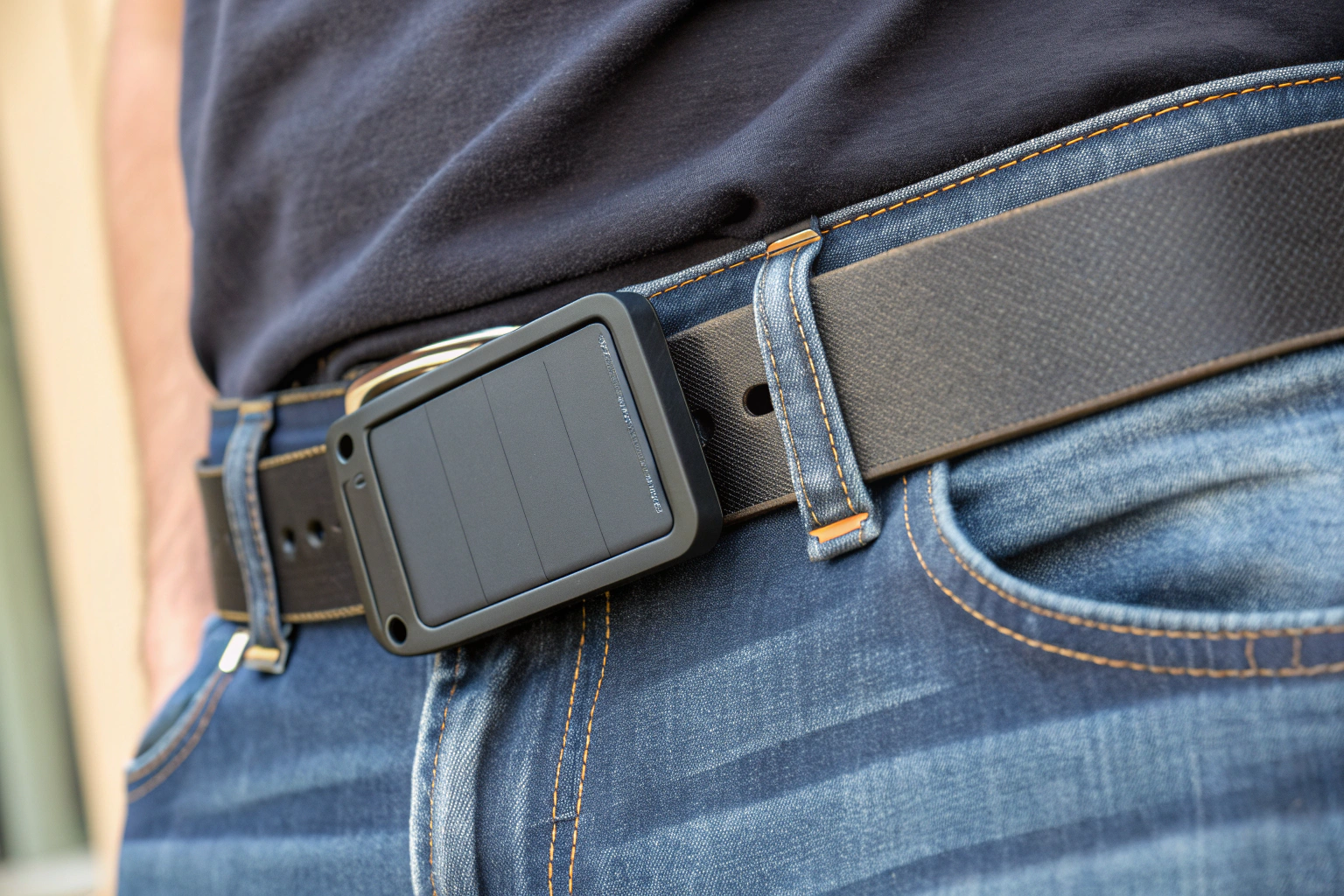
The buckle is an ideal host because it is centrally located on the body, providing a stable ground plane that can enhance GPS/cellular antenna performance; it offers a large, flat surface area perfectly oriented for ambient light exposure (whether indoors or out), ideal for solar harvesting; it is a item that is worn consistently with clothing, ensuring the tracker is always present; and its existing form factor disguises the technology, avoiding the "tracking device" stigma for the wearer.
Why is Solar Integration a Game-Changer for Battery Life?
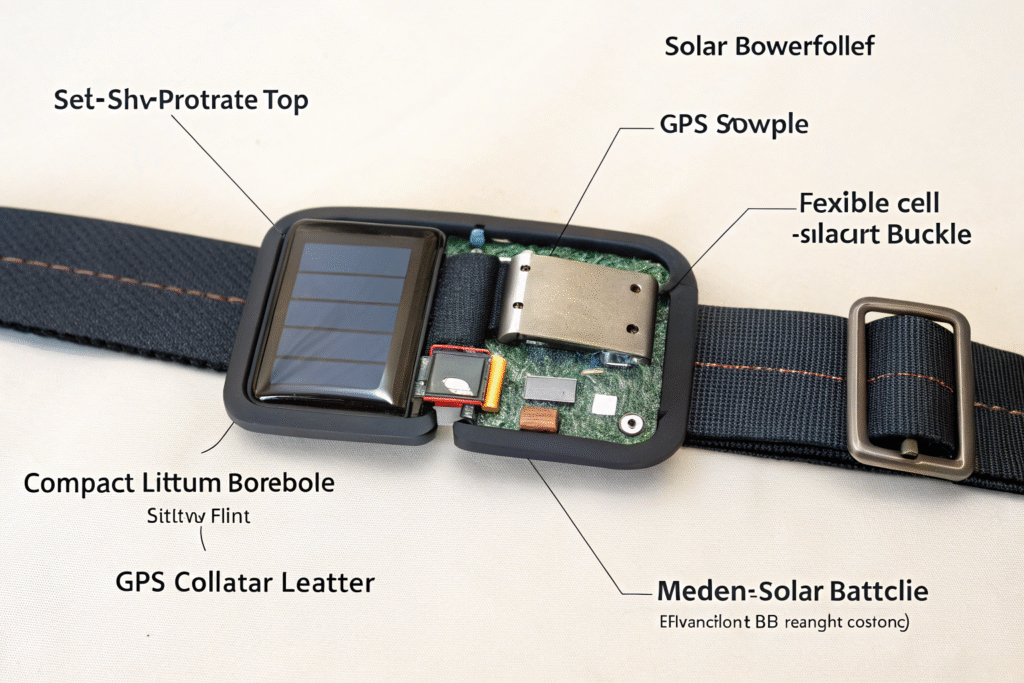
Traditional GPS trackers rely on internal batteries that last days or weeks, requiring frequent, inconvenient recharging. This creates reliability gaps—the moment you forget to charge it is when it's needed most. Integrating a high-efficiency, flexible thin-film solar cell (using amorphous silicon or CIGS technology) onto the buckle's face transforms it into a perpetual energy harvester.
- Ambient Light Charging: Modern low-power GPS modules and LTE-M/NB-IoT cellular chips consume minimal energy. A well-designed solar buckle can harvest enough energy from indoor lighting and daylight to operate indefinitely in a tracking mode that reports location several times a day. In active tracking mode, it can significantly extend battery life from days to months.
- Energy Storage: Instead of a traditional battery, some designs use a lithium-ion capacitor or a small solid-state battery that tolerates hundreds of thousands of charge cycles from the solar trickle charge, solving the battery degradation problem. This aligns with principles of energy harvesting for IoT.
How Does the Design Optimize Signal Reception?
The metal body of a traditional buckle can block RF signals. Smart buckle designs turn this into an advantage:
- Antenna Integration: The metal buckle itself can be engineered as part of the antenna system (a ground plane), or strategic plastic/composite windows can be used to allow signals to pass through.
- Elevated Position: On the waist, the buckle has a relatively clear path to the sky compared to a device in a pocket or bag, improving GPS fix times and accuracy.
This thoughtful RF and antenna design is critical for reliable performance and is a key differentiator between a hobbyist project and a professional-grade product.
What Are the Key Use Cases Driving Adoption?
The application for a solar-powered tracking buckle extends far beyond a simple "find my keys" scenario. Its combination of long-term autonomy, wearability, and discretion makes it uniquely suited for sensitive, long-duration monitoring scenarios where other devices fail or are socially inappropriate.
Primary use cases include: safety monitoring for children and individuals with dementia or special needs, where the device is discreet and cannot be easily removed or forgotten; asset and luggage tracking for frequent travelers, where the buckle can be attached to a bag or embedded in high-end luggage; personal safety for remote workers, hikers, and journalists in areas with limited power infrastructure; and corporate asset and personnel tracking in logistics, construction, or security fields.

How Does It Transform Care for Vulnerable Individuals?
For caregivers of individuals with Alzheimer's or autism who are prone to wandering, constant vigilance is exhausting. A wristband can be removed, and a phone can be left behind. A belt, however, is a familiar, non-threatening clothing item. A solar-powered tracker buckle on that belt provides:
- Non-Removable Security: It is less likely to be taken off compared to a dedicated medical alert device.
- Geo-Fencing: Caregivers can set up safe zones and receive instant alerts if the wearer leaves a designated area.
- Long-Term Autonomy: Eliminates the stress of weekly charging, which can be disruptive for the individual and burdensome for the caregiver.
This application sits at the intersection of assistive technology and wearable IoT, offering dignity alongside security.
Why is it Superior for High-Value Logistics and Travel?
For global shipping, luxury goods, or personal luggage, trackers are common, but they are often disposable single-use devices with non-replaceable batteries. A solar-powered tracker buckle offers a sustainable, reusable solution.
- Attached to Assets: It can be seamlessly integrated into the design of premium luggage or attached to shipping containers.
- Global Connectivity: Using low-power wide-area network (LPWAN) technologies like LTE-M or satellite modules, it can provide location updates across continents without needing local SIM swaps.
- Theft Deterrence & Recovery: Real-time location data can deter theft and aid in recovery, protecting valuable cargo and personal belongings.
This transforms a passive item into a smart, connected asset in the supply chain.
What Are the Core Technologies Enabling This Integration?
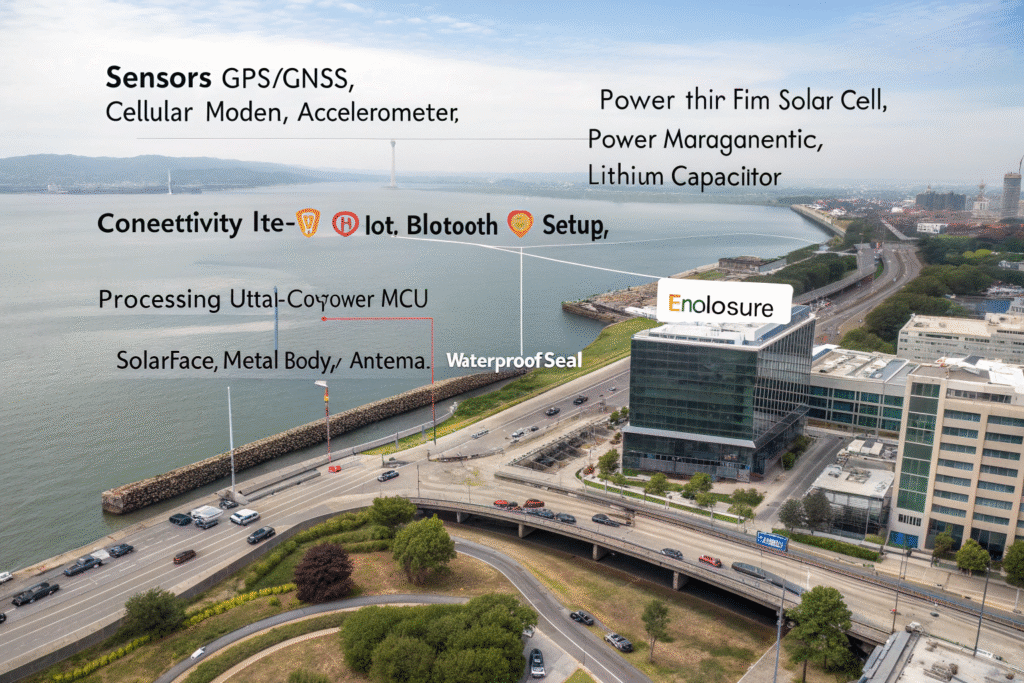
The magic of this product lies in the miniaturization and ultra-low-power optimization of several key technologies that, until recently, were too bulky or power-hungry to be combined in such a small, self-sufficient form factor. The buckle is not just a case; it's a highly integrated system-on-a-module (SoM).
Enabling technologies include: miniature multi-constellation GNSS modules (GPS, GLONASS, Galileo) for global positioning; LPWAN cellular chipsets (LTE-M, NB-IoT) designed for years of battery life on small cells; high-efficiency flexible solar cells with >20% conversion rates; ultra-low-power microcontrollers (MCUs) that spend most of their time in nanoamp sleep modes; and advanced power management integrated circuits (PMICs) that dynamically manage energy harvesting, storage, and consumption.
How Do LPWAN and GNSS Coexist on Minimal Power?
The communication strategy is key to longevity.
- LPWAN (LTE-M/NB-IoT): These cellular standards are built for the Internet of Things. They trade off high data rates for exceptional power efficiency and deep penetration. A tracker might "wake up" its LTE-M module once per hour to transmit a small data packet containing its location, consuming only a few milliampere-seconds of charge. This is managed by the MCU's real-time operating system.
- GNSS Duty Cycling: The GPS receiver doesn't need to be on continuously. The MCU can wake it up based on a schedule, motion detected by an accelerometer (geofence breach), or upon request from the cloud. Advanced chipsets like the u-blox SARA-R5 integrate LTE-M and GNSS in a single module with shared power management.
This orchestration of sleep, sense, and transmit cycles is the firmware's primary task, ensuring every microjoule from the solar cell is used efficiently.
What Solar and Energy Storage Tech is Used?
- Solar Cell: The choice is a monocrystalline silicon cell for maximum efficiency in direct sun (if space allows) or, more commonly for curved surfaces, a thin-film CIGS (Copper Indium Gallium Selenide) solar cell. CIGS is flexible, performs better in low-light conditions, and can be custom-shaped to fit the buckle's aesthetic.
- Energy Storage: Given the daily charge/discharge cycle, a standard Li-ion battery would degrade in 1-2 years. The solution is a Lithium Titanate (LTO) battery or a Lithium-Ion Capacitor (LIC). These have lower energy density but can handle millions of charge cycles, effectively lasting the lifetime of the product. This is a cornerstone of maintenance-free IoT.
How to Source and Develop Such a Complex Wearable?
Sourcing a solar-powered tracker buckle is at the apex of wearable tech complexity. It requires a partner that is not just an assembler, but a vertically integrated developer with expertise in RF design, low-power embedded systems, solar integration, and consumer product design. The development process is lengthy, capital-intensive, and requires navigating a thicket of global certifications.
Development requires: an OEM/ODM partner with full-stack capability in connected hardware; a multi-phase prototyping process focusing on power budget validation, RF performance, and user experience; rigorous environmental and durability testing (IP67/68, thermal cycling, UV exposure); managing global type approvals for cellular and radio equipment (FCC, CE, PTCRB, GCF); and establishing a cloud platform and mobile app for data visualization and alerts. This is typically a 12-18 month project from concept to mass production.
How to Vet a Potential Manufacturing Partner?
Ask these definitive questions:
- "Can you walk us through the power budget analysis for a typical user's day, from solar harvest to consumption, and show how you achieve energy neutrality or multi-month battery life?"
- "What is your process for antenna design and optimization in a metal-dominant wearable form factor? Can you share test reports for TRP/ TIS?"
- "How do you source and qualify the thin-film solar cells, and what is their guaranteed efficiency degradation over 5 years?"
- "What is your stack for device management, over-the-air (OTA) updates, and cellular connectivity management (eSIM provisioning)?"
- "Can you provide a detailed certification roadmap and handle the entire process for our target markets (US, EU, etc.)?"
A qualified partner will have detailed documentation, reference designs, and a clear development methodology. They should also discuss scalability—how to move from a custom, expensive prototype to a cost-optimized design suitable for mass production.
What are the Major Cost Drivers and Timeline Considerations?
- NRE (Non-Recurring Engineering): Very high ($250k - $1M+) due to custom RF design, firmware, tooling, and certification.
- Unit Cost: Driven by the cellular module, solar cell, and low-volume specialized components. Target Bill of Materials (BOM) for a high-quality unit might be $40-$80 at scale.
- Timeline: 4-6 months for prototypes and algorithm tuning, 6-8 months for certification (the longest pole), and 3-4 months for pilot production and ramp-up.
- Ongoing Costs: Cellular data subscription (per device, per month), cloud hosting, and app maintenance.
This is a venture for well-funded startups or established companies, not a side project. Success depends on a clear go-to-market strategy that justifies the investment, often focusing on B2B or high-margin B2C safety markets.
Conclusion
The integration of solar-powered location trackers into belt buckles is a masterclass in solving hard problems with elegant, convergent design. It addresses the fundamental limitations of battery life and user compliance that have plagued personal tracking for years, while leveraging the unique real estate of the buckle for optimal function and discretion. This innovation is powering new paradigms in personal safety, healthcare, and asset management.
For manufacturers and brands, it represents a significant technical and strategic undertaking, but one with the potential to define a leadership position in the connected wearable space. The key to success lies in selecting a development partner with deep, proven expertise across the entire stack—from the photovoltaic cell to the cloud dashboard—and in meticulously validating both the technology and the market need.
If you are envisioning a product that offers genuine, maintenance-free security and connectivity, developing a solar-powered smart buckle may be the ultimate solution. We possess the cross-disciplinary engineering teams and proven process to navigate this complex journey from concept to certified global product. Contact our Business Director, Elaine, to explore the potential of this transformative technology: elaine@fumaoclothing.com. Let's build a connected future that never loses power.