As sustainability becomes a non-negotiable for global brands and conscious consumers, the fashion accessories industry faces increasing pressure to prove its environmental credentials. For buyers sourcing belts, the term "carbon credits" is now part of the conversation. But how can you, as an importer or brand, be sure that the carbon neutrality claims attached to your leather belts or PU belts are legitimate and not just greenwashing? The verification process is the critical bridge between marketing claims and genuine environmental impact.
Verifying carbon credits in belt manufacturing requires a multi-step process focused on the credibility of the carbon offset project, the transparency of the manufacturer's emissions calculations, and the assurance provided by third-party certification standards like Verra's VCS or the Gold Standard. It involves checking the project's unique registry ID, its additionality (proving it wouldn't have happened without carbon finance), and ensuring it is not double-counted.
Simply claiming a product is "carbon neutral" because the factory purchased some offsets is no longer sufficient. Major supermarkets and fashion brands in Europe and America now demand rigorous, auditable proof. Let's break down how you can conduct due diligence and ensure your belt supply chain supports real climate action.
What are the recognized carbon credit standards for manufacturers?
Before trusting any carbon neutrality claim, you must identify the standard under which the carbon credits were issued. Not all standards are created equal; reputable ones have strict methodologies and independent auditing processes. For a belt manufacturer to make a verifiable claim, their offset purchases should be tied to credits from these major registries.
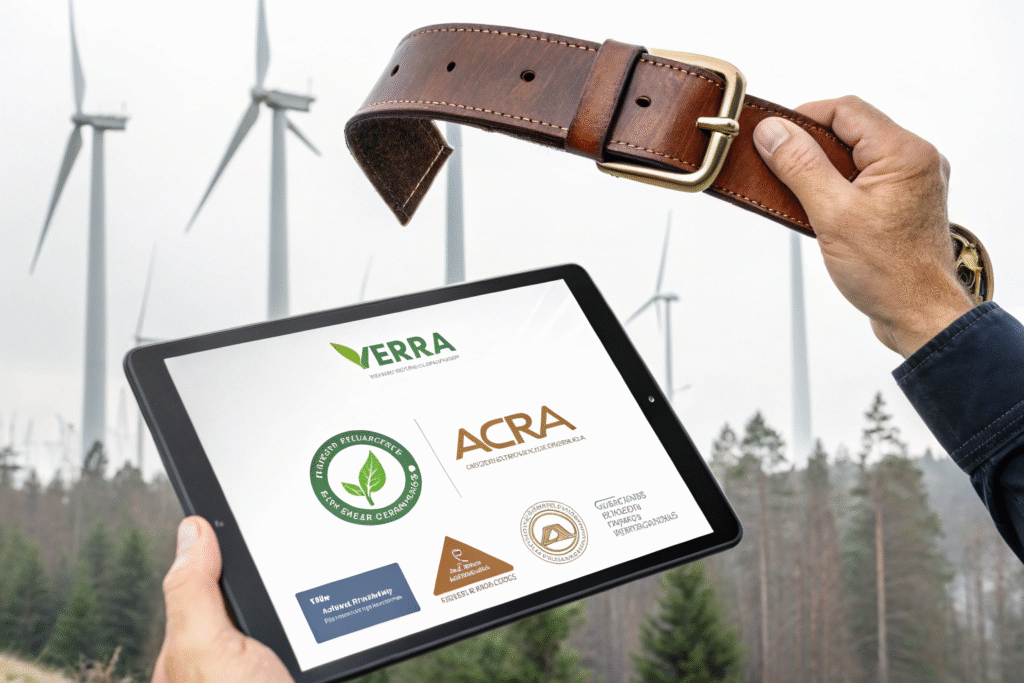
The most recognized and rigorous international carbon credit standards for manufacturers are Verra's Verified Carbon Standard (VCS), the Gold Standard, and the American Carbon Registry (ACR). These standards ensure that emission reduction projects are real, measurable, permanent, additional, and independently verified. Credits from these registries each have a unique serial number that can be publicly tracked to prevent fraud and double-counting.
Choosing a partner who understands and utilizes these standards is the first step toward credible sustainability. It moves the conversation from vague promises to specific, trackable assets.
Why is Verra's VCS considered a gold standard in verification?
Verra's Verified Carbon Standard (VCS) is often considered a benchmark because it operates the world's largest voluntary carbon market program. Its strength lies in its detailed, sector-specific methodologies for calculating emission reductions and its requirement for independent third-party validation and verification. For a belt factory, this could mean credibly offsetting emissions from energy use in cutting and stitching, or from the tanning process of genuine leather.
When a manufacturer retires VCS credits for your order, they can provide you with the unique project ID. You can then look up this ID on Verra's public registry to see the project details—whether it's a wind farm in India or a reforestation effort in South America. This level of transparency is why major brands trust VCS. It transforms a claim into a auditable transaction, giving you a concrete story for your fashion accessories marketing.
How does the Gold Standard address broader sustainability goals?
While the Gold Standard also ensures rigorous carbon accounting, it is uniquely focused on projects that deliver additional benefits aligned with the UN Sustainable Development Goals (SDGs). This means a Gold Standard-certified project doesn't just reduce carbon; it might also improve local health, create jobs, or protect biodiversity.
For a socially conscious brand, sourcing belts from a manufacturer using Gold Standard credits adds a deeper layer of impact. It signals that your purchase supports holistic community and environmental health, beyond just carbon math. This aligns perfectly with the values-driven purchasing of many modern consumers and can be a powerful point of differentiation for your trendy belt line, especially when targeting markets in Europe where sustainability scrutiny is high.
How to audit a factory's actual carbon footprint calculation?
The other half of verification is ensuring the "carbon neutral" claim is based on an accurate assessment of the factory's own footprint. Offsetting is meaningless if the baseline emissions are miscalculated or grossly underestimated. A credible manufacturer should be willing to open its books on this calculation.
Auditing a factory's carbon footprint calculation involves examining the boundaries of their assessment (e.g., is it only factory energy, or does it include raw materials and transportation?), the data sources for their energy consumption, and the emission factors they applied. You should look for alignment with the Greenhouse Gas (GHG) Protocol Corporate Standard and evidence of internal or external data audits.
A professional factory will have a documented process, often managed by their quality control team or a dedicated sustainability officer, showing how they measure, manage, and seek to reduce their emissions before offsetting the remainder.

What scope of emissions should a responsible footprint include?
According to the GHG Protocol, emissions are categorized into three scopes. A comprehensive and responsible carbon footprint for belt manufacturing should aim to include:
- Scope 1: Direct emissions from owned sources (e.g., gas boilers for heating).
- Scope 2: Indirect emissions from purchased electricity and heat.
- Scope 3: Other indirect emissions in the value chain. This is the most complex but most significant, including emissions from raw materials like leather or PU, transportation of goods, and even waste disposal.
While many factories start by offsetting Scopes 1 & 2, leading manufacturers are now beginning to address portions of Scope 3, particularly for key materials. Asking your supplier which scopes they include in their calculation and offsetting pledge is a crucial audit question. It separates those making a minimal effort from those committed to a holistic package transportation and customs clearance solution that includes environmental accountability.
Can you request a Life Cycle Assessment for specific belt products?
Yes, and this is the most thorough way to verify impact. A Life Cycle Assessment (LCA) is a scientific study that analyzes the environmental impact of a product from "cradle to grave"—from raw material extraction to end-of-life disposal. For a genuine leather belt, this would assess the impacts of cattle farming, tanning, manufacturing, shipping, use, and landfill decomposition.
Requesting an LCA for a flagship product, like your best-selling dress belt or woven belt, provides unparalleled transparency. It identifies "hotspots" for emission reduction and grounds any carbon neutrality claim in product-specific data. While conducting a full LCA requires expertise, it is a powerful tool that demonstrates a manufacturer's serious commitment to development capacity that includes environmental science, not just fashion design.
What documentation proves legitimate carbon credit retirement?
The final, crucial piece of verification is the proof that credits have been permanently retired on your behalf. This is the certificate that prevents the same ton of CO2 from being claimed by multiple companies. Without retirement proof, the claim is invalid.
Legitimate carbon credit retirement is proven by a publicly issued Retirement Certificate from the credit registry (e.g., Verra, Gold Standard). This certificate is a digital document that includes the unique serial numbers of the retired credits, the retirement date, the name of the retiring entity (your manufacturer), and often a beneficiary name (which can be your brand). This document is your immutable, legal proof of ownership of the climate action.
Any manufacturer making carbon-neutral claims should provide this certificate for the batch of belts you are purchasing. It is the equivalent of a title deed for environmental benefits.

How to use registry databases to track credit serial numbers?
The power of the major standards lies in their public transparency. Once you receive a Retirement Certificate, you can independently verify it. Each registry maintains a searchable public database. For example, on Verra's registry, you can enter the unique serial number from your certificate.
The database will show you the exact status of that credit: that it has been issued, retired, for whom, and on what date. It will also link back to the original project documentation. This simple, free check takes only minutes and is the most direct way for any buyer, from a large importer to an online store owner, to confirm the legitimacy of their supplier's environmental claims. It eliminates reliance on trust alone and introduces verifiable fact.
Should carbon neutrality claims be part of the official order contract?
Absolutely. For security and clarity, key sustainability promises should be formalized in the commercial agreement. This includes specifying the volume of products covered by the claim, the carbon credit standard to be used (e.g., VCS), and the requirement to provide the official Retirement Certificate as a condition for final payment.
Incorporating this into the contract protects your investment. It ensures that the "carbon neutral" status you are paying for—either as an included value-add or a specific line item—is delivered as promised. It aligns the manufacturer's incentives with yours and turns a marketing discussion into a binding component of your professional and reliable service. This practice is becoming standard among leading brands procuring from China and is a sign of a mature, transparent partnership.
Conclusion
Verifying carbon credits in belt manufacturing is no longer an optional, niche activity. It is a core due diligence process for building a credible, future-proof supply chain. By focusing on recognized standards, auditing footprint calculations, and demanding proof of credit retirement, you can ensure your sustainability investments are real and your brand is protected from accusations of greenwashing. This process transforms a complex environmental concept into a manageable, verifiable component of your sourcing checklist.
Moving toward a sustainable supply chain requires a partner who understands this landscape. If you are looking to develop or source belts with verifiable environmental credentials, we invite you to collaborate with a factory that is building transparency from the ground up. For a detailed discussion on integrating certified carbon neutrality into your next belt order, please contact our Business Director, Elaine. She can guide you through our processes and documentation. Reach out at elaine@fumaoclothing.com.