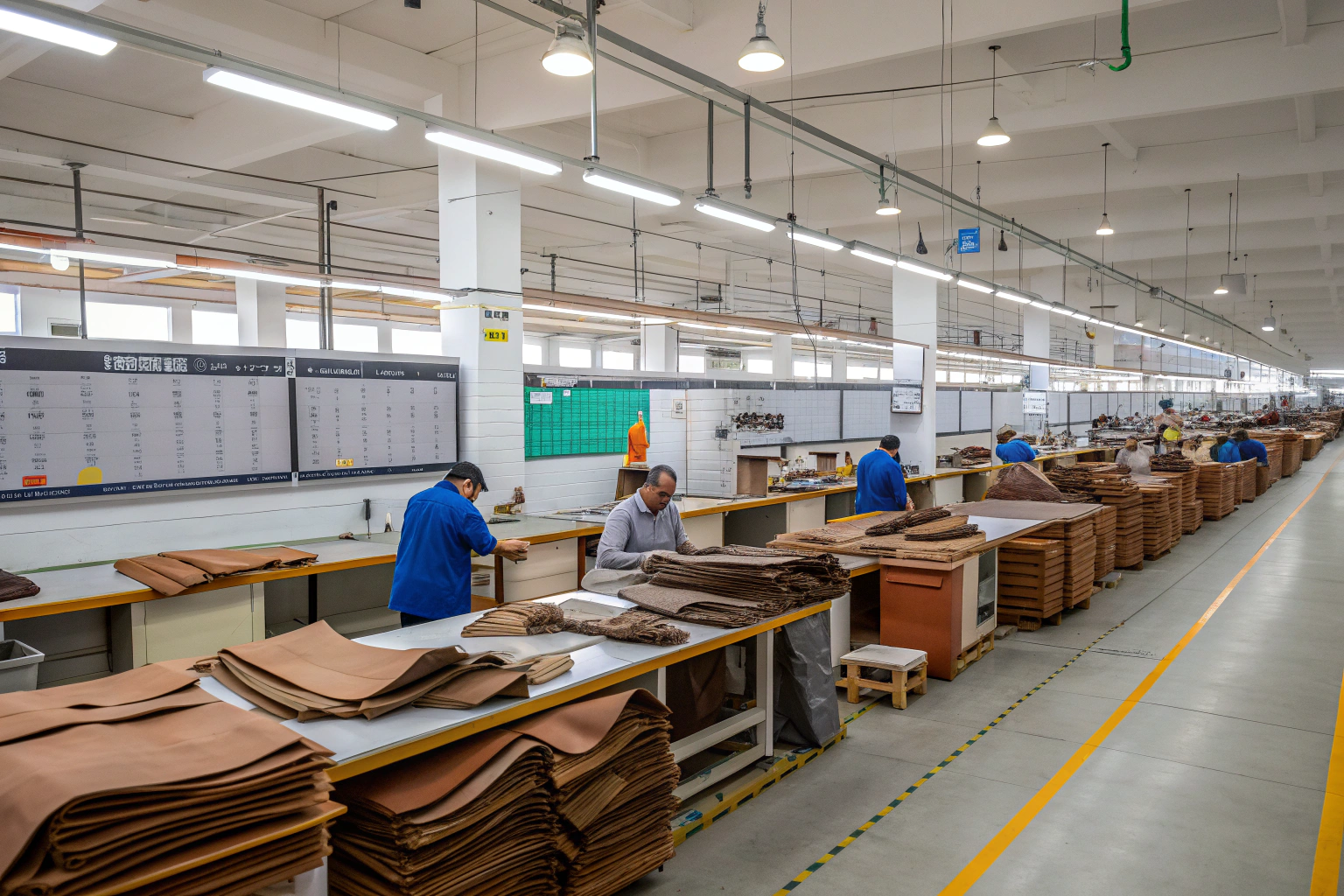
You walk through your factory and notice piles of cut leather waiting at each workstation. Finished belts accumulate in corners awaiting inspection. Workers frequently leave their stations to fetch materials. These aren't just minor inefficiencies—they're symptoms of a production system filled with waste that directly consumes your profit margin and slows your response to customer orders.
Implementing Lean Manufacturing in leather belt production means systematically identifying and eliminating waste to create more value with fewer resources. It's not about working faster but working smarter by streamlining material and information flow. The goal is building a responsive, efficient, quality-focused production system that adapts quickly to changing market demands.
This guide provides a practical framework for implementing Lean principles in your belt factory. We'll explore how to identify waste through value stream mapping, create continuous flow production cells, establish pull-based systems, and embed a culture of continuous improvement that involves every employee.
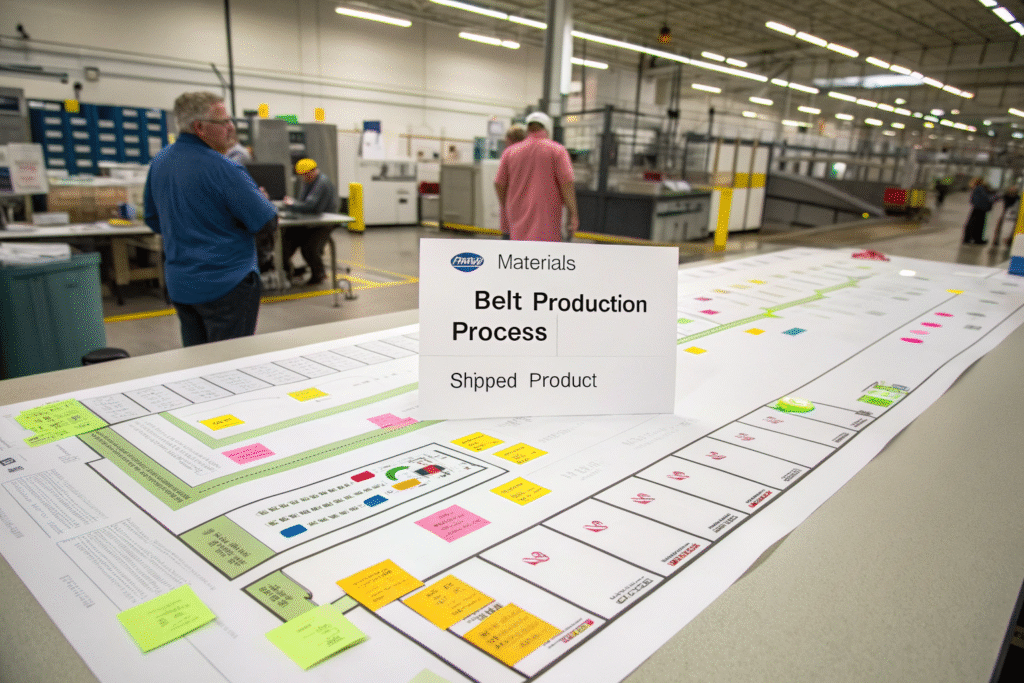
How to Identify Waste Through Value Stream Mapping?
In traditional manufacturing, waste often hides behind inventory and chaotic movement. Without seeing your complete process from raw material to shipped product, you can only guess where the biggest problems exist. Value Stream Mapping makes waste visible and provides the factual basis for improvement.
Value Stream Mapping is a simple diagram that illustrates every step in your belt production process, both value-added and non-value-added. By mapping the current state, you pinpoint exactly where time, materials, and effort are being wasted through unnecessary movement, waiting, overproduction, and other inefficiencies.
What Are the 8 Wastes in Leather Belt Manufacturing?
Lean philosophy identifies eight types of waste. Understanding these in your factory context is crucial:
- Transportation: Unnecessary movement of materials between distant workstations
- Inventory: Excess raw leather, work-in-progress, or finished goods tying up capital
- Motion: Workers wasting movement searching for tools, supplies, or information
- Waiting: Belts sitting idle between processes or awaiting decisions
- Overproduction: Making belts faster than customer demand requires
- Over-processing: Doing more work than customers value
- Defects: Producing faulty belts requiring rework or scrap
- Skills: Underutilizing workforce knowledge and creativity
How to Create Your Current State Map?
The mapping process begins with physically walking the process:
- Track a Single Belt: Follow one belt or small batch from leather receipt to shipping
- Collect Data: Note cycle times, wait times, inventory amounts, and people involved
- Identify Bottlenecks: Look for process steps where work accumulates
- Calculate Metrics: Determine value-added ratio and total lead time
This mapping often reveals that belts spend 95% of their production time waiting or moving, with only 5% actually being transformed—your primary improvement opportunity.
How to Create Continuous Flow Production Cells?
Batch processing creates delays and hides problems, while continuous flow exposes issues immediately for resolution. Transitioning from departmental batch production to dedicated production cells dramatically reduces lead time and improves quality.
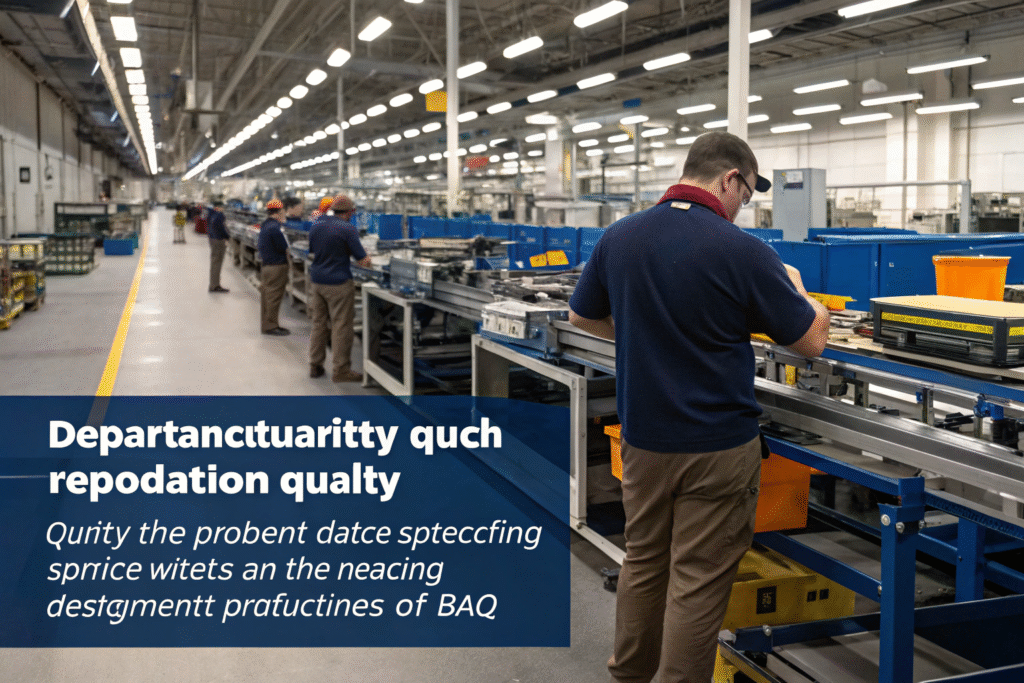
Production cells reorganize equipment and operators into compact arrangements where belts move one-piece-at-a-time to the next process. This eliminates batching and queueing between operations while making quality issues immediately visible.
What Does a Leather Belt Production Cell Look Like?
An effective cell arrangement might include:
- U-Shaped Layout: All operations within easy reach
- Sequenced Stations: Cutting → Skiving → Hole Punching → Stitching → Edging
- Standard Work: Clear instructions for each operation
- Visual Management: Status indicators and quality standards
How Does One-Piece Flow Reduce Lead Time?
The time difference is dramatic:
- Batch Processing: 100 belts cut → all 100 moved to skiving → all 100 to stitching = 2-week lead time
- One-Piece Flow: One belt cut → immediately skived → immediately stitched = 2-hour lead time
This 90%+ reduction in lead time creates massive competitive advantage and customer responsiveness for your belt production operations.
How to Establish Pull-Based Production Systems?
Push systems, based on forecasts, inevitably create overproduction—the worst form of waste. Pull systems ensure you only produce what downstream processes actually need, when they need it.
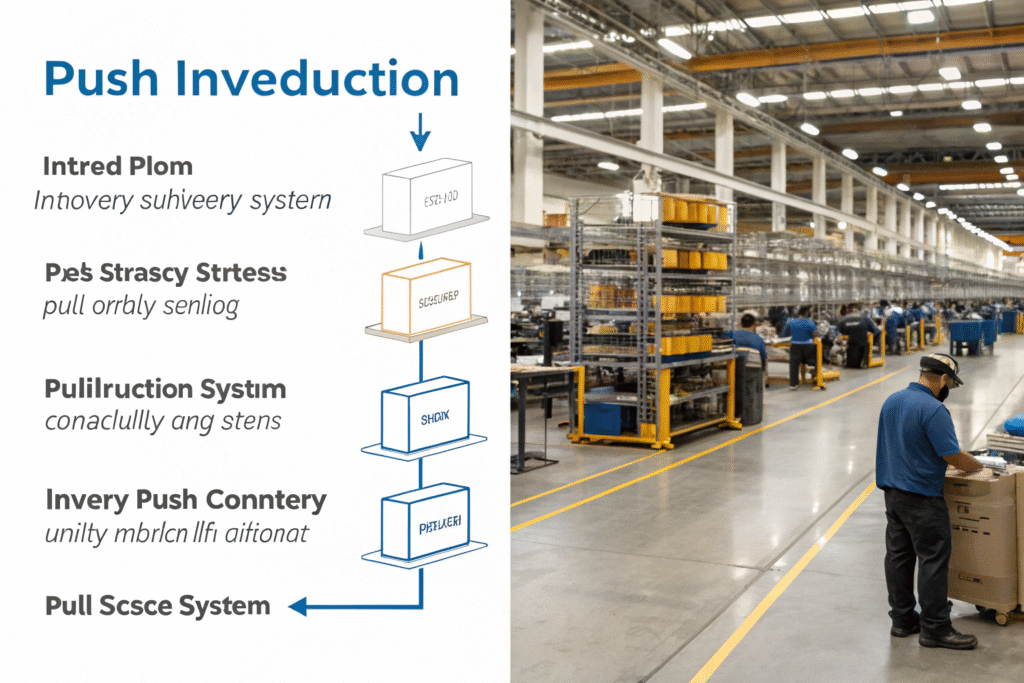
In pull production, nothing is made until there's a signal from a downstream customer process. This prevents overproduction and minimizes inventory while maintaining flow.
What is the Kanban Method for Belt Production?
Kanban uses simple visual signals to control production:
- Finished belts are taken from an outgoing kanban square
- The empty space signals the production cell to make more
- Production continues only to replace what was consumed
- The system self-regulates based on actual consumption
How Does Pull Respond to Real Demand?
Linking production directly to consumption creates powerful benefits:
- Dramatic Inventory Reduction: Work-in-progress typically drops 50-80%
- Quick Problem Detection: Production interruptions immediately visible
- Flexible Response: Easy to accommodate mix changes and special orders
- Space Savings: Less inventory means smaller facility requirements
This approach works exceptionally well for high-variety belt collections where demand patterns fluctuate.
How to Embed a Culture of Continuous Improvement?
Lean tools alone will fail without engaged people using them. The most powerful resource in any factory is the knowledge and creativity of frontline employees who understand the processes intimately.
A Lean culture builds on respect for people and the philosophy of Kaizen (continuous improvement). It empowers every employee to identify problems and implement small, incremental improvements daily.

What is the 5S Foundation?
5S creates the organized workplace essential for Lean success:
- Sort: Remove all unnecessary items from work areas
- Set in Order: Organize and label everything for easy use
- Shine: Clean the workplace and equipment daily
- Standardize: Create rules for maintaining the first three S's
- Sustain: Make 5S a habit and cultural norm
How to Empower Employees with Kaizen?
Practical approaches for engaging your workforce:
- Kaizen Boards: Visual systems for posting problems and improvement ideas
- Daily Stand-up Meetings: Brief team meetings to review safety, quality, and production
- Rapid Improvement Events: Focused team projects to tackle specific problems
- Suggestion Systems: Simple processes for capturing and implementing ideas
When a stitching operator suggests a jig that makes their work easier and reduces defects, that's Kaizen in action. This collective intelligence makes Lean transformation sustainable and powerful.
How to Measure Lean Implementation Success?
Without proper measurement, you can't distinguish real improvement from random variation. Lean implementation requires tracking the right metrics that reflect overall system performance rather than individual efficiency.
The most effective metrics focus on flow, quality, and customer responsiveness rather than traditional efficiency measures that often encourage overproduction and inventory buildup.
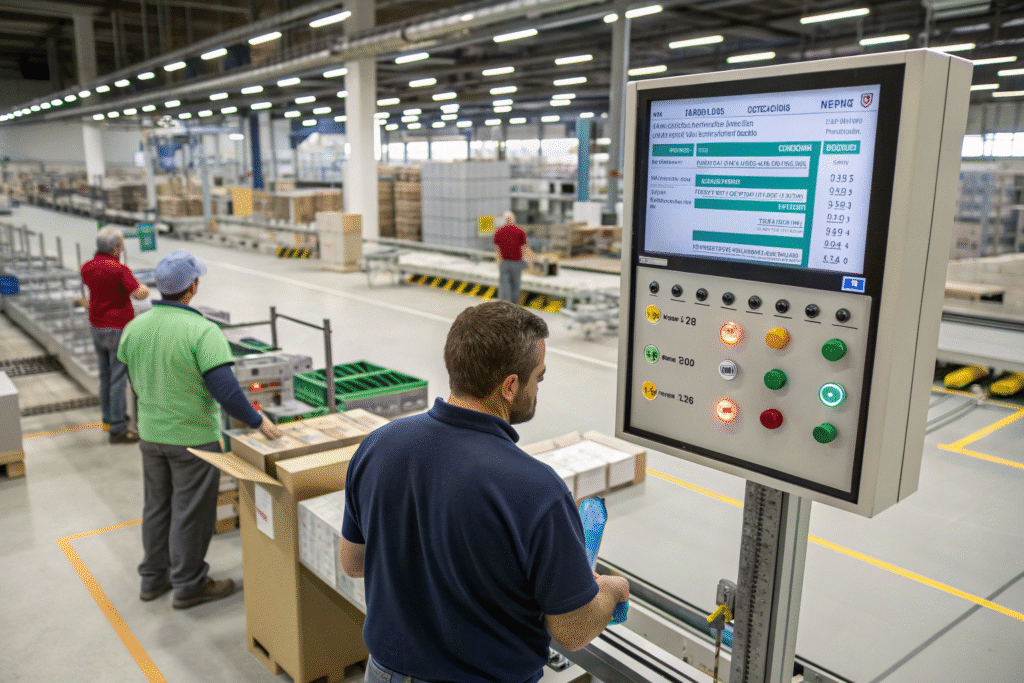
What Are the Key Performance Indicators?
Track these metrics to gauge your Lean progress:
| Metric | Before Lean | 6 Months Implementation | 12 Months Implementation |
|---|---|---|---|
| Production Lead Time | 15 days | 8 days | 3 days |
| First Pass Yield | 85% | 92% | 97% |
| Inventory Turns | 6x annually | 10x annually | 16x annually |
| Space Utilization | 100% (baseline) | 70% | 50% |
| Employee Suggestions | 2 per month | 12 per month | 30 per month |
How to Sustain and Deepen Lean Practices?
Long-term success requires ongoing commitment:
- Leader Standard Work: Clear expectations for managerial support of Lean
- Regular Gemba Walks: Managers spending time on the shop floor observing processes
- Continuous Training: Ongoing development of Lean knowledge and skills
- Visual Performance Tracking: Public display of key metrics and improvement activities
This systematic approach ensures Lean becomes your factory's cultural fabric rather than another "program of the month."
Conclusion
Implementing Lean Manufacturing in leather belt production transforms traditional batch-and-queue systems into efficient, responsive flow. The journey begins with Value Stream Mapping to identify waste, continues with creating continuous flow cells to eliminate that waste, establishes pull systems to prevent overproduction, and is sustained by engaging employees in continuous improvement. This systematic approach reduces lead times by 70-90%, improves quality by 30-50%, and increases productivity by 25-45% while creating a more engaged workforce. The result is a competitive advantage that delivers exactly what customers want, when they want it, with minimal waste.
If you're ready to transform your leather belt production with Lean Manufacturing principles, our factory has successfully implemented these methods and can help you begin your journey. Contact our Business Director, Elaine, at elaine@fumaoclothing.com to discuss how Lean Manufacturing can revolutionize your operations.